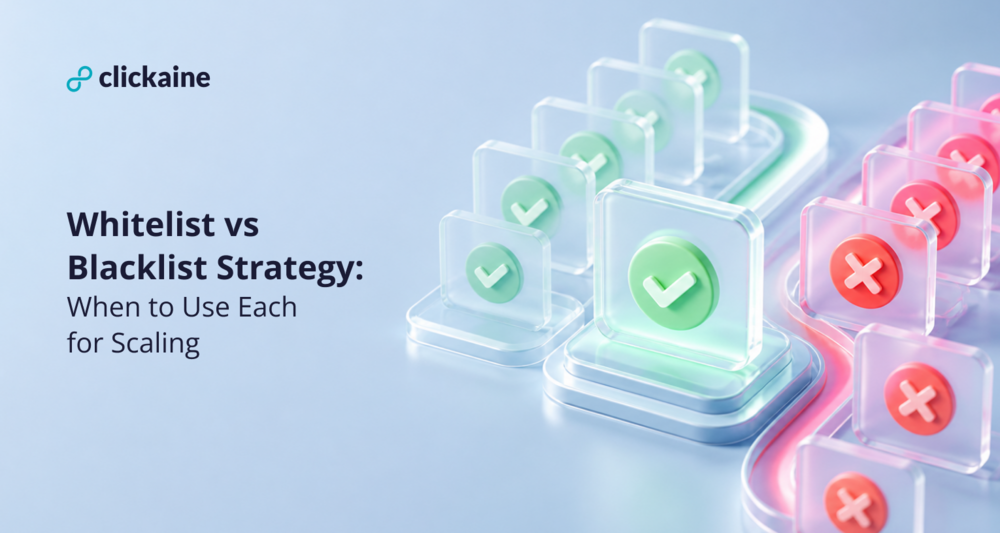
Whitelist vs Blacklist Strategy: When to Use Each for Scaling
Scaling a campaign is not only about increasing budget.
Many advertisers think that once a campaign starts showing results, the next step is simple: raise bids, add more traffic, and let the volume grow. Sometimes that works. But often, scaling too fast without traffic control leads to wasted budget, unstable performance, and weaker ROI.
That is where whitelist and blacklist strategies come in.
Both help advertisers optimize traffic, but they work in different ways:
- A whitelist helps you focus budget on traffic sources that already perform well.
- A blacklist helps you remove sources that clearly do not perform.
The real question is not which one is better. The real question is: when should you use each one?
What Is a Whitelist?
A whitelist is a selected group of traffic sources, placements, zones, or PubIDs that have already shown strong results.
When you run a whitelist campaign, your ads are shown only on approved sources. Instead of buying traffic from the full available inventory, you focus only on placements that have proven they can deliver value.
For example, if you test a campaign across multiple PubIDs and notice that several sources consistently bring conversions at an acceptable CPA, those sources can be moved into a whitelist campaign.
This gives you more control, better budget focus, and more predictable performance.
| Whitelist Strategy | What It Means |
| Main goal | Scale proven traffic sources |
| Traffic access | Narrow and controlled |
| Best stage | After testing |
| Main benefit | Stable ROI |
| Main risk | Limited discovery |
Whitelist strategy works best when you already have data. It is not ideal at the very beginning of a campaign, because you may limit traffic before discovering all potential winners.
What Is a Blacklist?
A blacklist is the opposite approach.
Instead of choosing only the best sources, you continue running broader traffic while excluding placements that perform badly.
If a source spends budget without conversions, brings weak engagement, or shows poor post-click behavior, you can add it to a blacklist. Your campaign will continue receiving traffic from the rest of the inventory, but avoid sources that are wasting spend.
Blacklist strategy is especially useful during testing and early optimization because it keeps the campaign open to new opportunities.
| Blacklist Strategy | What It Means |
| Main goal | Remove poor-performing traffic |
| Traffic access | Broad, with exclusions |
| Best stage | Testing and early scaling |
| Main benefit | Keeps discovery open |
| Main risk | Some budget waste during learning |
In simple terms:
Whitelist = scale winners.
Blacklist = remove losers.
Whitelist vs Blacklist: The Core Difference
Both strategies help improve performance, but they solve different problems.
A whitelist is selective. It narrows your campaign to traffic sources that already work.
A blacklist is flexible. It keeps the campaign open while removing sources that clearly do not work.
| Factor | Whitelist | Blacklist |
| Best use | Scaling | Testing and cleaning |
| Traffic volume | Lower but more controlled | Higher but less predictable |
| Discovery potential | Limited | Strong |
| Budget efficiency | Higher after data is collected | Improves gradually |
| Risk | Missing new winners | Spending on weak sources |
| Best timing | After enough conversions | During early optimization |
If you whitelist too early, you may block sources that simply did not have enough time to prove themselves.
If you blacklist too late, you may let bad traffic burn too much budget.
The best advertisers usually use both strategies together.
When to Use a Blacklist Strategy
A blacklist strategy is best when you are still learning.
At the beginning of a campaign, you usually do not know which placements, PubIDs, creatives, or GEO segments will perform best. You need data before making strong optimization decisions.
This is why blacklisting is useful when you are:
- launching a new campaign;
- testing a new GEO;
- trying a new offer;
- testing new creatives or landing pages;
- exploring a new vertical;
- collecting enough data before scaling.
The goal is not to blacklist every source that fails once. The goal is to remove clear patterns of poor performance.
For example, if your target CPA is $20 and a source spends $2 with no conversions, that is probably not enough data. But if it spends $30–40 with no conversions, no funnel progress, and weak engagement, it may be time to remove it.
| Blacklist Signal | What It May Mean |
| High spend with no conversions | Source may not fit the offer |
| Many clicks but no actions | Low intent or weak relevance |
| Very high bounce rate | Poor traffic quality or landing mismatch |
| No funnel progress | Users are not interested |
| Repeated poor performance | Source should likely be excluded |
A good blacklist strategy requires balance. You need enough patience to collect data, but enough discipline to stop wasting budget.
When to Use a Whitelist Strategy
A whitelist strategy becomes powerful once you know what works.
After the testing stage, you may notice that certain PubIDs or placements consistently generate conversions at a good CPA. These sources can then be separated into a whitelist campaign and scaled with more confidence.
Whitelist strategy is useful when:
- you have enough conversion data;
- specific sources show stable ROI;
- you want better budget control;
- you are ready to increase bids or budgets;
- you want to reduce exposure to unknown traffic;
- you need more predictable performance.
A whitelist campaign is not about guessing. It is about investing more into sources that already proved their value.
| Whitelist Signal | Why It Matters |
| Stable conversions | Shows repeatable performance |
| Acceptable CPA | Keeps scaling profitable |
| Enough traffic volume | Makes scaling worthwhile |
| Good engagement | Indicates stronger user quality |
| Performance across several days | Reduces the chance of lucky results |
| Works with multiple creatives | Shows real source-offer fit |
One lucky conversion is not enough to build a whitelist. Strong whitelist sources should show repeatable value.
The Biggest Mistake: Whitelisting Too Early
One of the most common advertiser mistakes is creating a whitelist before there is enough data.
It is easy to see a few early conversions and assume that a source is a winner. But early performance can be misleading.
A placement may convert once and then stop. Another source may look weak at first but become profitable after more volume. Some PubIDs may need a different creative or landing page before showing their real potential.
When you whitelist too early, you can accidentally limit your campaign before it has enough room to grow.
| Too-Early Whitelist Problem | Result |
| Small sample size | Wrong sources selected |
| Limited traffic pool | Scaling becomes harder |
| Missed new sources | Potential winners stay undiscovered |
| Overdependence on few placements | Performance becomes unstable |
| Early assumptions | Optimization becomes less accurate |
A better approach is to start broader, use blacklist strategy to remove weak traffic, and build a whitelist only from consistent winners.
The Second Mistake: Blacklisting Too Late
The opposite mistake is letting bad traffic run for too long.
Some advertisers hesitate to blacklist sources because they want more data. Data is important, but there is a point where waiting becomes expensive.
If a source has already spent a meaningful amount compared to your target CPA and shows no conversions or useful engagement, keeping it active may only drain budget from better opportunities.
The goal of blacklisting is not to make the campaign perfect immediately. The goal is to remove obvious waste before it damages the whole campaign.
A practical rule:
| If a source has… | Then you should… |
| Low spend and no conversions | Wait for more data |
| Medium spend and weak engagement | Monitor closely |
| High spend and no funnel progress | Consider blacklisting |
| Repeated poor results | Blacklist or retest later with changes |
| Good engagement but no conversions | Check landing page or offer first |
Not every non-converting source is bad. Sometimes the issue is the creative, funnel, bid, or landing page. But repeated poor performance should not be ignored.
How to Use Both Strategies Together
The strongest scaling strategy usually combines blacklist and whitelist logic.
At launch, start broad enough to collect useful data. During early optimization, blacklist sources that clearly do not perform. Once you identify consistent winners, move them into a separate whitelist campaign.
This creates two campaign layers:
| Campaign Layer | Purpose | Strategy |
| Testing campaign | Discover new sources | Broad targeting + blacklist |
| Scaling campaign | Grow proven sources | Whitelist + higher focus |
This setup is much stronger than trying to test and scale everything inside one campaign forever.
Your testing campaign keeps discovering new opportunities.
Your whitelist campaign focuses budget on sources that already work.
As new winners appear in the testing campaign, you can move them into the whitelist. If a whitelisted source starts underperforming, you can lower bids, pause it, or retest it later.
Practical Example
Imagine you launch a campaign with a $500 test budget.
At first, you run broad traffic across different PubIDs. After the first round of data, you notice that some sources spend quickly but bring no conversions and poor engagement. You add them to a blacklist.
After more testing, you identify 8–10 PubIDs that consistently generate conversions at or below your target CPA.
Instead of simply increasing the budget on the original campaign, you create a separate whitelist campaign with those proven PubIDs.
Now your structure looks like this:
| Campaign | Role |
| Broad campaign with blacklist | Continues testing and discovering new sources |
| Whitelist campaign | Scales the best-performing PubIDs |
This gives you both discovery and control.
The broad campaign keeps finding new potential winners. The whitelist campaign scales what already works.
That is how scaling becomes more predictable.
How Budget Size Affects the Strategy
Your budget affects how quickly you can collect data and how aggressive your optimization should be.
With a small budget, you need to be careful not to cut sources too early, but also avoid letting weak sources spend too much.
With a larger budget, you can test broader, collect data faster, and build whitelist campaigns sooner.
| Budget Level | Recommended Approach |
| Small budget | Test moderately broad, blacklist carefully, whitelist only clear winners |
| Medium budget | Use blacklist during testing, then create whitelist campaigns |
| Large budget | Run separate testing and scaling campaigns at the same time |
| Aggressive scaling budget | Keep discovery campaigns active while scaling whitelist campaigns |
The larger the budget, the faster you can learn. But the rule stays the same: optimize based on patterns, not assumptions.
Lifehacks for Better Scaling
Whitelist and blacklist strategies become much more effective when you use them as part of a system, not as one-time actions.
Here are a few practical lifehacks:
- Keep testing and scaling in separate campaigns when possible.
- Increase bids more confidently on whitelist sources.
- Keep broader campaigns active to discover new winners.
- Do not blacklist based on tiny spend.
- Do not whitelist based on one lucky conversion.
- Review lists regularly because traffic quality can change.
- Recheck old blacklist decisions after changing creatives, offers, or landing pages.
- Use micro-conversions when conversion volume is low.
Micro-conversions can include:
| Micro-Signal | Why It Helps |
| Landing page click | Shows basic interest |
| Form start | Indicates stronger intent |
| Scroll depth | Shows engagement |
| Time on page | Helps evaluate traffic quality |
| Add to cart / registration step | Shows funnel progress |
| Repeat visit | Indicates higher-quality traffic |
These signals help you make smarter decisions before you have a large number of final conversions.
How Often Should You Review Lists?
Whitelist and blacklist strategy is not “set and forget.”
Traffic changes. Competitors change. Bids change. Creatives become tired. A source that worked last week may slow down today, and a source that failed before may perform better with a new funnel.
During the first days of a campaign, review lists frequently. Once the campaign becomes stable, you can review them less often, but they should still be checked regularly.
| Campaign Stage | Review Frequency |
| First 24–72 hours | Often |
| Active testing | Daily |
| Stable scaling | Several times per week |
| Mature campaign | Weekly or after major changes |
| New creative or offer | Restart evaluation |
A whitelist is not a trophy case.
A blacklist is not a graveyard.
Both are working tools that should evolve with your campaign.
Final Thoughts
Whitelist and blacklist strategies are both essential for advertisers who want to scale efficiently.
A blacklist helps you test broader traffic while removing sources that clearly waste budget. It is best for learning, exploration, and early optimization.
A whitelist helps you focus budget on sources that already perform. It is best for controlled scaling, stable ROI, and stronger budget efficiency.
The best approach is not choosing one forever. It is knowing when to use each.
Start broad enough to learn.
Blacklist what clearly does not work.
Whitelist what consistently performs.
Keep testing new sources while scaling proven ones.
That is how advertisers move from random traffic buying to predictable growth.