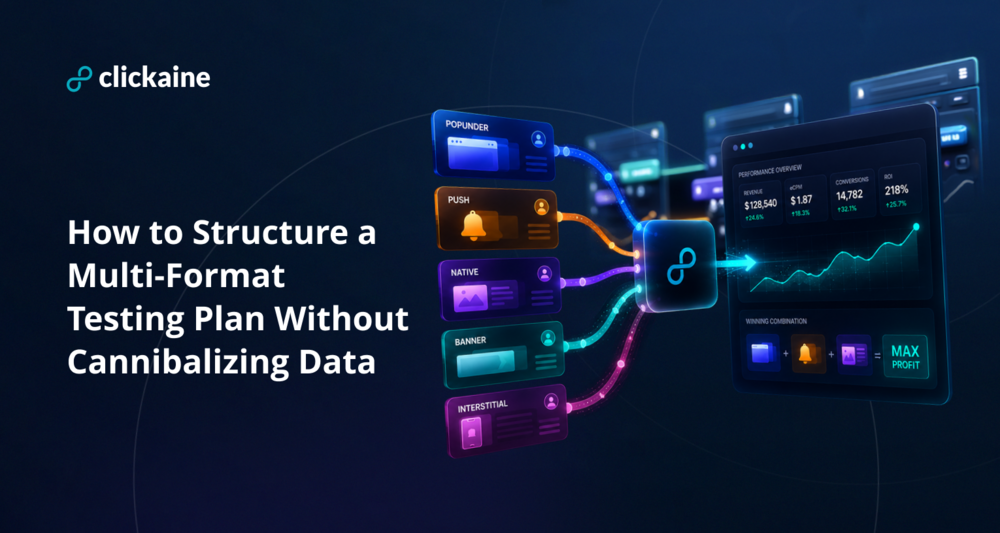
How to Structure a Multi-Format Testing Plan Without Cannibalizing Data
Testing multiple ad formats can help advertisers find new growth opportunities faster. But there is one common problem: when campaigns are not structured properly, formats start competing with each other, data becomes mixed, and optimization decisions become unclear.
This is called data cannibalization.
It happens when several formats, campaigns, or targeting groups overlap so much that you can no longer understand what is actually driving performance. Was it Popunder? Push? Native? A specific GEO? A creative? A landing page? Or just repeated exposure to the same users?
A good multi-format testing plan helps advertisers compare formats fairly, protect data quality, and scale based on clear performance signals.
Why Multi-Format Testing Matters
Different formats reach users in different moments and mindsets.
- Popunder can bring high-volume traffic and is useful for broad testing.
- Push can work well for direct-response offers and repeat engagement.
- In-Page Push can reach users without requiring subscription.
- Native can perform well with content-driven funnels.
- Banner can support visibility and retargeting-style exposure.
- Video or Interstitial formats can help when the offer needs stronger attention.
The goal is not to find a “perfect” format immediately. The goal is to understand which format works best for each offer, GEO, device, and funnel.
The Main Risk: Testing Everything at Once
Many advertisers launch several formats at the same time with the same targeting, same offer, same landing page, and same budget logic.
At first, this looks efficient. In reality, it often creates messy data.
| Poor Testing Setup | Result |
| Same GEOs across all formats | Hard to know which format performs best |
| Same budget for all formats without rules | Strong formats may be underfunded |
| Same landing page for every format | User intent may not match the funnel |
| No separate tracking structure | Data becomes mixed |
| Optimizing too early | Winners and losers are misread |
When formats overlap too much, they can influence each other. One format may introduce the user to the offer, while another gets the conversion. Without a clean structure, the wrong format may get credit or be paused too early.
Step 1: Define One Main Testing Goal
Before launching, decide what you want to learn.
Do not test formats, creatives, GEOs, landers, offers, and bid strategies all at once. Choose the main question first.
Examples:
- Which format gives the best CPA for this offer?
- Which format brings the highest conversion rate?
- Which format works best for Tier 2 GEOs?
- Which format is best for mobile traffic?
- Which format gives the most scalable traffic volume?
A clear testing goal helps you avoid random decisions.
| Testing Goal | What to Compare |
| Find the best format | Same offer, same GEO, same device, different formats |
| Find the best GEO | Same format, same offer, different GEOs |
| Find the best funnel | Same format and GEO, different landing pages |
| Find scaling potential | Best format + best GEO + higher volume sources |
Step 2: Separate Campaigns by Format
The easiest way to avoid data cannibalization is to create a separate campaign for each format.
For example:
- Campaign 1: Popunder — Turkey — Mobile
- Campaign 2: Push — Turkey — Mobile
- Campaign 3: In-Page Push — Turkey — Mobile
- Campaign 4: Native — Turkey — Mobile
This structure keeps reports clean and makes comparison easier.
| Format | Campaign Structure |
| Popunder | Separate campaign with its own budget and tracking link |
| Push | Separate campaign with separate creatives and metrics |
| In-Page Push | Separate campaign, even if targeting is similar |
| Native | Separate campaign with content-style creatives |
| Banner | Separate campaign for visibility and CTR testing |
Do not mix several formats in one campaign when your goal is to compare performance. Mixed campaigns may be easier to launch, but harder to optimize.
Step 3: Keep Core Variables Stable
To compare formats fairly, keep the main variables as similar as possible.
At the beginning, try to keep consistent:
- GEO;
- device type;
- operating system;
- offer;
- payout model;
- landing page;
- conversion goal;
- tracking setup;
- testing period.
This allows you to see how the format itself performs.
| Variable | Why Keep It Stable |
| GEO | Different markets behave differently |
| Device | Mobile and desktop can convert differently |
| Offer | Different offers have different conversion logic |
| Landing page | Funnel changes can distort format comparison |
| Tracking | Data must be measured the same way |
| Time period | Weekend and weekday traffic may differ |
Once you know which format performs best under controlled conditions, you can start testing more variables.
Step 4: Use Separate Tracking Links and UTM Logic
Each format should have its own tracking link or tracking parameters.
This helps you analyze performance not only at campaign level, but also by format, publisher, placement, creative, GEO, device, and funnel step.
Recommended tracking structure:
| Parameter | Example |
| Traffic source | Clickaine |
| Format | Popunder / Push / Native |
| Campaign name | Offer_GEO_Device_Format |
| Publisher ID | Dynamic token |
| Creative ID | Dynamic token |
| Placement ID | Dynamic token |
| Landing page ID | Dynamic token |
This makes your reports easier to read and helps you avoid mixing performance signals.
A good naming system also saves time when you scale. You should be able to look at a campaign name and immediately understand what it is testing.
Step 5: Give Each Format Enough Budget and Time
A common mistake is judging formats too quickly.
Some formats collect data faster than others. Popunder may generate volume quickly, while Native or Push may need more time to show stable results.
Avoid making decisions based on a few clicks or one conversion.
| Format Type | Testing Note |
| High-volume formats | Can collect data faster, but need strict filtering |
| Engagement-based formats | May need more creative testing |
| Content-driven formats | Often require landing page alignment |
| Lower-volume formats | Need more time before conclusions |
A practical approach:
- define a minimum test budget per format;
- define a minimum number of visits or clicks;
- wait for enough conversions before scaling;
- compare CPA, ROI, EPC, and conversion rate, not only CTR.
The goal is to make decisions based on patterns, not lucky results.
Step 6: Avoid Audience Overlap Where Possible
If the same users see the same offer through several formats at the same time, attribution can become confusing.
To reduce overlap, you can:
- test formats in separate time windows;
- separate GEOs or device groups;
- use different landing pages for different user intent;
- control frequency where available;
- avoid launching too many similar campaigns at once.
| Risk | How to Reduce It |
| Same users see the offer too often | Limit frequency or separate testing windows |
| One format assists another | Track funnel steps and compare assisted impact |
| Data gets mixed | Use separate campaigns and parameters |
| Budget competition | Assign fixed test budgets per format |
You do not always need zero overlap. But you need enough separation to understand performance clearly.
Step 7: Match the Funnel to the Format
Different formats often require different funnel logic.
A Popunder user may need a fast-loading, direct landing page. A Native user may respond better to a pre-lander or educational angle. A Push user may react to a stronger call to action. A Banner user may need repeated exposure before converting.
| Format | Funnel Recommendation |
| Popunder | Fast page, simple message, clear CTA |
| Push | Direct offer, strong headline, urgency |
| In-Page Push | Simple flow, mobile-friendly design |
| Native | Pre-lander, story angle, soft conversion |
| Banner | Clear visual, recognizable offer, retargeting-style logic |
If one format performs poorly, the format itself may not be the problem. The funnel may simply not match the user’s mindset.
Step 8: Compare Formats by Business Metrics
CTR can be useful, but it should not be the main decision metric.
A format with a high CTR may still bring low-quality traffic. Another format may have lower engagement but stronger conversion value.
Focus on:
- CPA;
- conversion rate;
- EPC;
- ROI;
- profit;
- approval rate;
- retention or deposit quality, if relevant;
- scalability.
| Metric | Why It Matters |
| CTR | Shows initial interest |
| CVR | Shows funnel efficiency |
| CPA | Shows cost per result |
| EPC | Shows traffic value |
| ROI | Shows profitability |
| Profit | Shows real business impact |
| Volume | Shows scaling potential |
The best format is not always the cheapest. It is the one that brings stable, scalable, profitable results.
Step 9: Build a Simple Decision Framework
Before launching tests, define what happens after the data comes in.
For example:
| Result | Action |
| High ROI + enough volume | Scale gradually |
| Good ROI + low volume | Test more publishers or GEOs |
| High CTR + low CVR | Improve landing page or offer match |
| Low CTR + good CVR | Test new creatives |
| High spend + no conversions | Pause or reduce bid |
| Mixed results | Segment by GEO, device, publisher |
This prevents emotional decisions and keeps optimization consistent.
Step 10: Scale Winners Without Breaking the Test
Once you find a winning format, do not immediately change everything.
Scale step by step:
- increase budget gradually;
- expand to similar GEOs;
- add new publishers carefully;
- test new creatives separately;
- keep the original winning campaign stable;
- duplicate campaigns for new tests instead of changing the main one.
This protects your best-performing setup while still allowing new experiments.
| Scaling Mistake | Better Approach |
| Increase budget too aggressively | Scale in controlled steps |
| Change landing page and bid together | Change one variable at a time |
| Add many GEOs into one campaign | Create separate GEO campaigns |
| Edit the winning campaign too much | Duplicate and test separately |
A clean scaling structure helps you grow without losing control of performance data.
Final Thoughts
Multi-format testing can reveal strong growth opportunities, but only if the data stays clean.
To avoid cannibalization:
- separate campaigns by format;
- keep core variables stable;
- use clear tracking parameters;
- give each format enough budget and time;
- reduce unnecessary audience overlap;
- match funnels to user intent;
- compare formats by ROI and profit, not just clicks;
- scale winners gradually.
The goal is not to test more randomly. The goal is to test smarter.
When each format has its own structure, budget, tracking, and optimization logic, advertisers can understand what really works — and scale with confidence.