How to Diagnose Campaign Performance Before Increasing the Budget
Increasing the budget is one of the most exciting parts of campaign management. The campaign is converting, the numbers look promising, and the next logical step seems obvious: spend more.
But scaling too early can quickly turn a profitable campaign into an expensive test. Before increasing the budget, advertisers need to understand not only whether the campaign is working, but why it is working — and whether that performance is stable enough to handle more traffic.
A strong pre-scale diagnosis helps you avoid wasting budget, identify weak spots, and scale with more confidence.
Why Pre-Scale Diagnostics Matter
A campaign can look profitable on the surface while still hiding problems that appear only after budget increases.
For example, one traffic source may be carrying most of the results. A few early conversions may make CPA look better than it really is. Or CTR may be strong, but users drop after the click because the landing page does not match the ad angle.
Before scaling, advertisers should check the full funnel:
- ad engagement
- traffic quality
- landing page behavior
- conversion rate
- CPA stability
- source-level performance
- payout and margin
The goal is simple: make sure the campaign has a real foundation, not just a lucky short-term result.
1. Start With CTR: Is the Ad Getting Attention?
CTR shows whether your ad is attractive enough to generate clicks. A low CTR may mean the creative, headline, offer, or audience match needs improvement.
However, a high CTR does not automatically mean the campaign is ready to scale. It only means users are clicking. The next question is whether those clicks are valuable.
| CTR Situation | What It May Mean | What to Check Before Scaling |
| Low CTR | Weak creative or poor audience match | Test new angles, creatives, headlines |
| High CTR, low CR | Clickbait effect or poor landing page match | Check landing page relevance and user behavior |
| Stable CTR across sources | Healthy ad engagement | Compare with CPA and CR before increasing budget |
| CTR drops over time | Creative fatigue | Refresh creatives before scaling |
A good CTR is useful only when it leads to quality post-click behavior.
2. Check CR: Are Users Actually Converting?
Conversion rate shows how efficiently clicks turn into leads, registrations, sales, or other target actions. If CTR is strong but CR is weak, the problem usually happens after the click.
This can be caused by:
- landing page mismatch
- unclear offer
- slow page loading
- too many form fields
- weak call-to-action
- poor traffic quality
- wrong GEO or device targeting
Before increasing the budget, compare CR by traffic source, placement, device, browser, GEO, and time of day. A campaign may look average overall, but the details often show exactly where the profitable traffic is coming from.
3. Look at CPA Stability, Not Just CPA
CPA is one of the main metrics advertisers use when deciding whether to scale. But looking only at the current CPA can be misleading.
A campaign with 3 conversions at a good CPA is not the same as a campaign with 50 conversions at a similar CPA. The second one gives you much more confidence.
| Campaign Result | Scaling Risk | Recommendation |
| Good CPA, very few conversions | High | Keep testing before scaling |
| Good CPA, stable conversions over several days | Lower | Consider gradual budget increase |
| CPA changes strongly day by day | Medium to high | Check source mix and conversion volume |
| CPA is profitable only on one source | Medium | Scale that source carefully, do not scale everything |
The more stable the CPA is across time and traffic segments, the safer it is to increase the budget.
4. Analyze Source Quality
Not all traffic sources perform equally. Before scaling, advertisers should understand which sources are actually driving results.
Do not look only at total conversions. Check the quality of each source based on the full funnel.
| Source Metric | Why It Matters |
| CTR | Shows whether users respond to the ad |
| CR | Shows whether clicks convert |
| CPA | Shows cost efficiency |
| Bounce rate | Helps detect weak post-click engagement |
| Time on page | Shows whether users interact with the landing page |
| Conversion consistency | Helps identify reliable sources |
| Payout margin | Shows whether the source is worth scaling |
A source with cheap clicks is not always the best source. Sometimes a more expensive source brings better users, stronger CR, and a more stable CPA.
Before scaling, separate sources into three groups:
- Scale: stable conversions, profitable CPA, good margin
- Optimize: mixed results, needs bid or targeting adjustments
- Pause: poor CR, high CPA, weak post-click behavior
This helps you increase spend where it makes sense instead of pushing more budget into the entire campaign blindly.
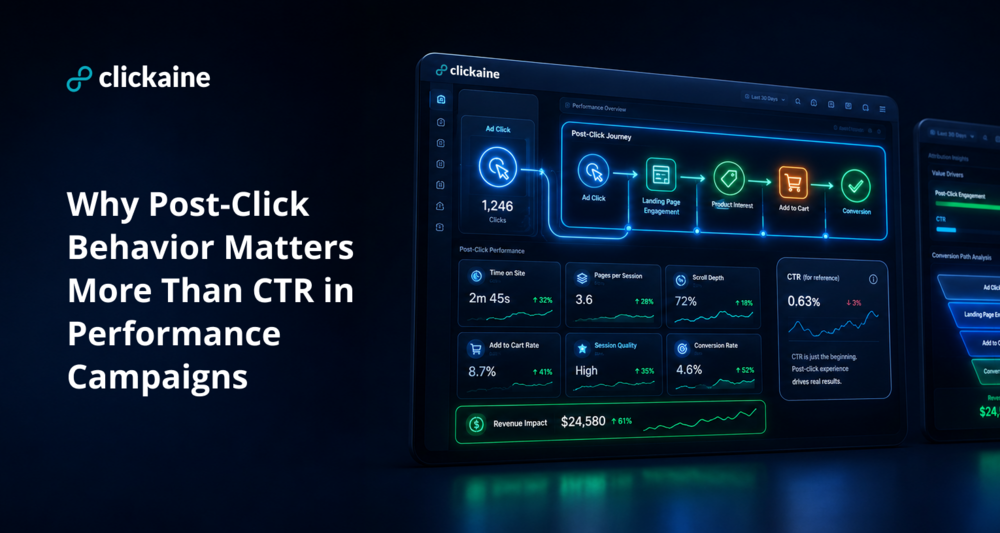
5. Review Post-Click Behavior
Post-click behavior is often where advertisers find the real reason behind campaign performance.
A campaign may have good CTR and enough traffic, but if users leave the landing page too quickly, the issue is probably not the ad. It may be the page experience.
Before scaling, check:
- page loading speed
- bounce rate
- scroll depth
- button clicks
- form starts vs. form completions
- time on page
- device performance
- landing page errors
For example, if mobile users click the ad but do not convert, test the page on mobile. The form may be too long, the button may be hard to find, or the page may load slowly.
Small landing page issues become expensive when the budget increases.
6. Check Conversion Stability Over Time
One good day is not enough reason to scale aggressively. Campaign performance can change depending on traffic volume, weekday, competition, source rotation, or audience behavior.
Before increasing the budget, review performance across several days.
Ask yourself:
- Are conversions coming every day or only randomly?
- Is CPA stable or jumping too much?
- Does performance depend on one source?
- Are results consistent across devices and GEOs?
- Does the campaign still work after small bid or budget changes?
If the campaign performs well only during a short window, scaling may expose instability. A safer approach is to increase the budget gradually and continue monitoring key metrics.
7. Calculate Payout Margin Before Scaling
Profitability matters more than volume. A campaign can generate many conversions and still be risky if the margin is too small.
Before scaling, calculate the difference between your payout and CPA.
| Payout | CPA | Margin | Scaling Decision |
| $10 | $8 | $2 | Possible, but monitor closely |
| $10 | $9.50 | $0.50 | Too risky for aggressive scaling |
| $10 | $6 | $4 | Stronger room for scaling |
| $10 | $11 | -$1 | Optimize before scaling |
A thin margin can disappear quickly when traffic volume grows. If CPA increases even slightly, the campaign may become unprofitable.
A healthy margin gives you more flexibility to test higher volumes, new sources, and bid adjustments.
Practical Pre-Scale Checklist
Before increasing the budget, make sure you can answer “yes” to most of these questions:
- CTR is stable and not dropping quickly
- CR is strong enough compared to your target CPA
- CPA is profitable across more than a few conversions
- top-performing sources are clearly identified
- weak sources are paused or optimized
- landing page behavior looks healthy
- conversions are stable over several days
- payout margin leaves enough room for traffic fluctuations
- tracking works correctly across the full funnel
- budget increase plan is gradual, not aggressive
If several answers are “no,” the campaign probably needs more optimization before scaling.
Final Thoughts
Scaling should not be based only on excitement or one profitable day. Before increasing the budget, advertisers need to diagnose the campaign from every angle: ad engagement, traffic quality, conversion behavior, CPA stability, and payout margin.
The best campaigns are not always the ones with the highest CTR or the cheapest clicks. They are the ones with stable, measurable, and repeatable performance.
Once you understand what drives the results, scaling becomes much safer. Instead of simply spending more, you invest more into the parts of the campaign that already prove they can perform.