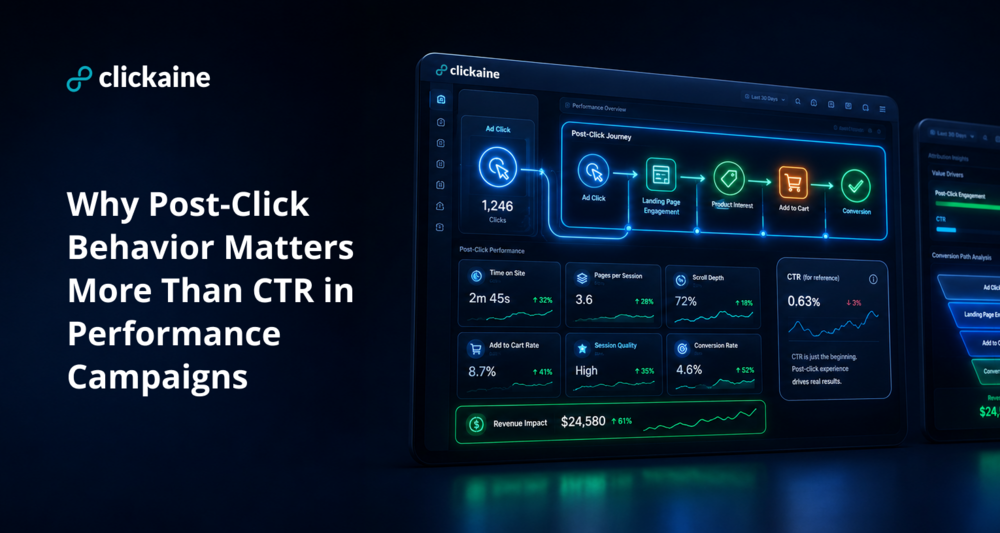
Why Post-Click Behavior Matters More Than CTR in Performance Campaigns
CTR has always been one of the first metrics advertisers look at. A high click-through rate often feels like proof that a campaign is working. After all, if people are clicking, the ad must be doing something right.
But here’s the reality: clicks don’t generate revenue—conversions do.
Many campaigns with impressive CTRs never become profitable because the real problems start after the click. That’s why experienced performance marketers spend just as much time analyzing post-click behavior as they do optimizing creatives.
If users click but immediately leave, don’t engage with the landing page, or fail to convert, CTR alone tells only a small part of the story.
CTR Is the Beginning, Not the Goal
A strong CTR simply means your creative captured attention. It says nothing about whether the traffic is actually interested in your offer.
Think of CTR as getting people through the front door. Post-click behavior tells you whether they decided to stay.
| Metric | What It Measures | What It Doesn’t Tell You |
| CTR | Interest in the ad | Whether visitors convert |
| Bounce Rate | Immediate exits | Why users left |
| Time on Page | User engagement | Whether they completed the funnel |
| Conversion Rate | Funnel efficiency | Traffic quality by itself |
| CPA | Acquisition cost | Where performance issues begin |
Looking at only CTR is like judging a movie by its trailer.
What Happens After the Click?
Once users land on your page, every second matters.
Advertisers should ask questions like:
- Are visitors staying on the page?
- Are they scrolling through the content?
- Do they interact with buttons or forms?
- Where do they leave the funnel?
- Is behavior different across devices or GEOs?
These answers often reveal optimization opportunities that creative testing alone cannot solve.
For example, a campaign with an average CTR but excellent landing page engagement may outperform another campaign with twice the CTR but a much higher bounce rate.
Common Signs of Poor Post-Click Performance
Sometimes the problem isn’t the traffic—it’s the experience users encounter after clicking.
Watch for these warning signs:
- High bounce rate
- Very short session duration
- Low scroll depth
- High form abandonment
- Large differences between desktop and mobile performance
- Strong CTR but weak conversion rate
These metrics usually indicate friction somewhere in the funnel.
Why Landing Page Experience Matters
Imagine an ad promising a limited-time offer.
The user clicks.
The landing page loads slowly, the headline doesn’t match the ad, and the call-to-action sits below several long paragraphs.
Most users won’t wait.
Small issues become expensive when you’re buying thousands of clicks.
Before increasing traffic, review:
- page loading speed
- message consistency between ad and landing page
- mobile usability
- form length
- CTA visibility
- navigation distractions
Improving the landing page often produces a larger performance lift than launching new creatives.
A Practical Example
Consider two campaigns with identical budgets.
| Metric | Campaign A | Campaign B |
| CTR | 3.8% | 2.4% |
| Bounce Rate | 72% | 34% |
| Time on Page | 18 sec | 1 min 42 sec |
| Conversion Rate | 0.9% | 3.6% |
| CPA | $18 | $7 |
At first glance, Campaign A looks stronger because it generates more clicks.
But Campaign B attracts visitors who actually engage with the offer and convert, resulting in a much lower CPA.
The lesson is simple: quality interactions outperform empty clicks.
The Metrics That Deserve More Attention
Instead of focusing exclusively on CTR, advertisers should evaluate the entire customer journey.
A healthy performance campaign typically shows:
- stable conversion rate
- reasonable bounce rate
- strong engagement time
- consistent CPA
- good landing page interaction
- profitable return on ad spend
When these metrics improve together, scaling becomes much safer.
How to Improve Post-Click Performance
Optimizing post-click behavior doesn’t always require major redesigns. Small improvements often make a measurable difference.
Start with this checklist:
- Match your landing page headline with the ad message.
- Improve loading speed, especially on mobile.
- Place the main CTA above the fold.
- Remove unnecessary form fields.
- Test different landing page layouts.
- Analyze user behavior by traffic source and GEO.
- Monitor engagement before increasing budgets.
Many advertisers focus heavily on acquiring clicks while spending very little time improving what happens afterward. In reality, both stages deserve equal attention.
Final Thoughts
A high CTR may look impressive in reports, but it doesn’t guarantee profitable campaigns. Performance marketing is about what happens after users click—not simply getting them to click in the first place.
By paying closer attention to post-click behavior, advertisers gain a much clearer picture of traffic quality, landing page effectiveness, and overall campaign health.
The strongest campaigns aren’t always the ones with the highest CTR. They’re the ones where visitors stay, engage, convert, and generate sustainable returns.
Improve Your Campaign Performance with Clickaine
Success in performance marketing isn’t about generating more clicks—it’s about turning those clicks into valuable conversions. By understanding post-click behavior, optimizing your landing pages, and continuously analyzing user engagement, you can build campaigns that scale profitably.
At Clickaine, we help advertisers reach high-quality audiences with traffic designed for performance. Whether you’re testing a new offer or scaling a winning campaign, our optimization tools and dedicated support can help you maximize ROI at every stage of the funnel.
Ready to improve your campaign performance? Join Clickaine today and turn quality traffic into better results.