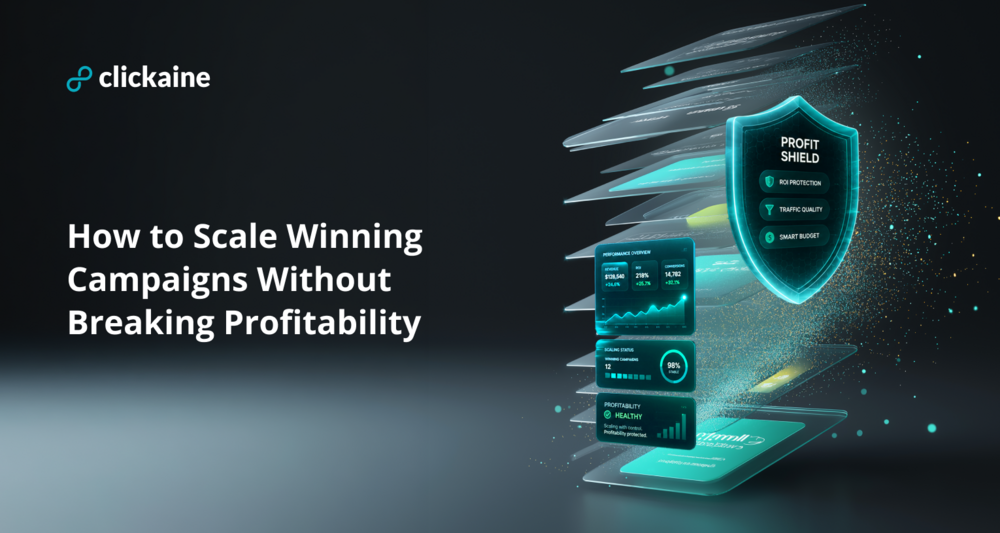
How to Scale Winning Campaigns Without Breaking Profitability
Finding a winning campaign is exciting. You see stable conversions, positive ROI, and a clear opportunity to grow. The natural reaction is simple: increase the budget and scale as fast as possible.
But this is where many advertisers lose profitability.
Scaling is not just about spending more. A campaign that works at $100 per day may not behave the same way at $1,000 per day. Traffic quality can change, competition can increase, conversion rates can drop, and the funnel may stop performing at the same level.
The goal is to scale winning campaigns while keeping control over ROI, CPA, and profit.
Why Profitable Campaigns Break During Scaling
A campaign can lose performance during scaling for several reasons:
- budget is increased too aggressively;
- new traffic sources are added without testing;
- bids are raised too fast;
- frequency becomes too high;
- the same creative gets exhausted;
- landing pages become overloaded or less relevant;
- weak segments are scaled together with strong ones;
- optimization decisions are based on short-term results.
| Before Scaling | After Poor Scaling |
| Stable CPA | CPA starts increasing |
| Positive ROI | ROI becomes unstable |
| Clear winning segments | Mixed traffic quality |
| Controlled spend | Budget wasted faster |
| Strong creative performance | Creative fatigue appears |
| Clean data | Harder optimization |
A winning campaign should be scaled carefully, not randomly.
1. Start by Understanding Why the Campaign Wins
Before increasing the budget, identify what exactly makes the campaign profitable.
Look at performance by:
- GEO;
- device;
- OS;
- browser;
- publisher;
- placement;
- creative;
- landing page;
- time of day;
- day of week;
- offer;
- audience segment.
A campaign may look profitable overall, but only because one or two segments are carrying the result.
| Campaign Segment | Performance | Action |
| GEO A + Mobile | High ROI | Scale carefully |
| GEO B + Desktop | Break-even | Keep testing |
| GEO C + Mobile | Negative ROI | Exclude or reduce |
| Publisher 1 | Stable conversions | Add to whitelist |
| Publisher 2 | High spend, no conversions | Pause |
Do not scale the whole campaign until you know which parts are actually working.
2. Increase Budget Gradually
One of the safest scaling methods is gradual budget growth.
Instead of doubling or tripling spend overnight, increase budgets step by step and monitor how performance reacts.
A practical approach:
- increase budget by 20–30%;
- wait for enough data;
- check CPA, ROI, CVR, and profit;
- increase again only if performance remains stable.
| Scaling Method | Risk Level | Best Use |
| +20–30% budget increase | Low | Stable campaigns |
| 2x budget increase | Medium | Strong campaigns with enough data |
| 5x+ budget increase | High | Only when traffic depth is proven |
| Unlimited scaling | Very high | Usually unsafe without strict controls |
Scaling too fast can push the campaign into weaker inventory, higher competition, or less qualified users.
3. Separate Scaling Campaigns From Testing Campaigns
Do not turn your winning campaign into a testing playground.
Once you have a profitable setup, keep it stable. If you want to test new GEOs, creatives, formats, or landing pages, duplicate the campaign and test changes separately.
| Wrong Approach | Better Approach |
| Change the winning campaign directly | Keep the winner stable |
| Add new GEOs into the main campaign | Create a separate GEO test |
| Replace creatives all at once | Test new creatives in a duplicate |
| Change bid, lander, and offer together | Change one variable at a time |
| Mix test traffic with scaling traffic | Separate test and scale budgets |
This helps protect the campaign that already works while still allowing growth experiments.
4. Scale by Segments, Not by Guessing
The best way to scale is to expand from proven segments.
For example, if your campaign works on mobile Android traffic in one GEO, you can test:
- similar GEOs;
- similar publishers;
- the same GEO with a higher budget;
- the same format with new creatives;
- similar devices or operating systems;
- lookalike traffic behavior;
- new placements with controlled budgets.
| Winning Segment | Smart Scaling Direction |
| Turkey + Mobile + Popunder | Test nearby GEOs or similar markets |
| Android traffic converts well | Expand Android first |
| One publisher performs strongly | Build a whitelist around similar sources |
| One creative angle wins | Test variations of the same angle |
| Evening traffic performs best | Increase budget during strong hours |
Scaling works better when it follows the data.
5. Watch CPA and ROI, Not Just Revenue
During scaling, revenue may increase while profitability drops.
This is one of the biggest traps. A campaign can generate more conversions and more revenue, but if CPA grows faster than earnings, the campaign becomes less profitable.
Track:
- CPA;
- ROI;
- profit;
- revenue;
- cost;
- conversion rate;
- EPC;
- approval rate, if relevant;
- lifetime value, if available.
| Metric | What It Tells You |
| Revenue | How much the campaign earns |
| Cost | How much you spend |
| Profit | What remains after costs |
| ROI | Whether scaling is efficient |
| CPA | Cost per result |
| CVR | Funnel quality |
| EPC | Traffic value |
The goal is not just to spend more. The goal is to keep the margin healthy while spend increases.
6. Build Whitelists and Blacklists
Scaling becomes safer when you know which sources deserve more budget and which ones should be excluded.
Use performance data to create:
- whitelists of strong publishers, placements, or zones;
- blacklists of low-quality or unprofitable sources;
- separate campaigns for top-performing sources;
- controlled test campaigns for new inventory.
| Source Type | Action |
| High ROI, stable volume | Add to whitelist |
| Good conversions, low volume | Test higher bid or more budget |
| High spend, no conversions | Add to blacklist |
| Many clicks, no value | Pause or reduce |
| New source, no data yet | Test with limited budget |
A strong whitelist can become the base for profitable scaling. A clean blacklist helps protect the budget.
7. Control Bids Carefully
Higher bids can unlock more traffic, but they can also damage profitability.
When you increase bids, you may enter new auction levels or attract different traffic quality. Sometimes a small bid increase can improve volume without hurting CPA. Other times it can quickly make the campaign unprofitable.
| Bid Change | Possible Result |
| Small increase | More volume with manageable risk |
| Large increase | Higher spend and unstable CPA |
| Lower bid | Better efficiency but less volume |
| Separate bids by segment | More control over profitability |
Instead of raising bids everywhere, adjust them by segment.
For example:
- increase bids only for profitable GEOs;
- reduce bids for break-even placements;
- keep test sources at lower bids;
- use higher bids only for whitelisted traffic.
8. Refresh Creatives Before Performance Drops
Creative fatigue can appear quickly when you scale.
As more users see the same ad, CTR may decline, conversion rate may drop, and CPA may rise. This does not always mean the campaign is dead. It may mean the creative needs new variations.
Test variations of:
- headlines;
- images;
- calls to action;
- value propositions;
- urgency angles;
- benefit-focused messages;
- localized creatives;
- landing page headlines.
| Creative Situation | Recommended Action |
| CTR drops | Test new headlines or visuals |
| CTR is high, CVR is low | Improve message match with landing page |
| One angle works well | Create similar variations |
| Creative is overused | Refresh before scaling harder |
| Different GEOs respond differently | Localize creative angles |
Do not wait until the campaign collapses. Prepare new creatives while the current ones are still working.
9. Keep Landing Pages Fast and Relevant
Scaling sends more users into your funnel. If the landing page is slow, unclear, or not matched to the traffic, profitability can drop quickly.
Check:
- loading speed;
- mobile optimization;
- message match between ad and landing page;
- clear CTA;
- simple user flow;
- localized language where needed;
- tracking accuracy;
- page stability under higher traffic volume.
| Landing Page Issue | Impact |
| Slow loading | Higher bounce rate |
| Weak CTA | Lower conversion rate |
| Poor mobile UX | Lost mobile traffic |
| Message mismatch | Low user trust |
| Too many steps | More drop-offs |
| No localization | Lower engagement in some GEOs |
A good campaign can lose money because of a weak landing page. Scaling makes this problem more expensive.
10. Use Time and Dayparting Data
Not all traffic performs equally throughout the day or week.
Some campaigns convert better in the evening. Others perform stronger on weekdays or weekends. If you scale without considering timing, you may spend more during weak periods.
Analyze:
- conversions by hour;
- CPA by hour;
- ROI by day;
- traffic volume by time period;
- performance during weekends and holidays.
| Time Segment | Possible Action |
| High ROI hours | Increase budget or bid |
| Low ROI hours | Reduce spend |
| Strong weekends | Allocate more budget |
| Weak weekdays | Limit testing |
| Event-driven spikes | Prepare campaigns early |
Dayparting can help scale without wasting budget during low-performing periods.
11. Set Clear Stop-Loss Rules
Even winning campaigns can have bad periods.
Before scaling, define when you will pause, reduce, or review the campaign.
Examples of stop-loss rules:
- pause a placement after a certain spend with no conversions;
- reduce budget if CPA increases above target;
- pause a creative if CTR drops below a benchmark;
- stop scaling if ROI falls below minimum acceptable level;
- review landing page if CVR drops sharply.
| Signal | Action |
| Spend reaches test limit with no conversions | Pause source |
| CPA exceeds target by 30%+ | Reduce bid or budget |
| ROI turns negative | Stop scaling and analyze |
| CVR drops suddenly | Check funnel and tracking |
| CTR drops over time | Refresh creatives |
Stop-loss rules protect you from emotional decisions and uncontrolled spending.
12. Scale in Layers
The strongest scaling strategy is layered, not chaotic.
A good sequence can look like this:
- Scale the best publisher or placement.
- Increase budget gradually.
- Test similar sources.
- Expand to similar GEOs.
- Refresh creatives.
- Test new formats separately.
- Increase bids only on proven segments.
- Keep monitoring profitability.
| Scaling Layer | Risk Level |
| More budget to proven segments | Low |
| Similar publishers or placements | Low to medium |
| Similar GEOs | Medium |
| New formats | Medium |
| New offers | Higher |
| Broad targeting expansion | High |
Each layer should be tested and validated before moving to the next.
Summing up
Scaling winning campaigns is not about pushing more budget as fast as possible. It is about growing carefully while protecting profitability.
To scale without breaking performance:
- understand why the campaign is winning;
- increase budgets gradually;
- separate testing from scaling;
- scale by segments;
- monitor CPA, ROI, and profit;
- build whitelists and blacklists;
- control bids;
- refresh creatives;
- keep landing pages fast;
- use time-based data;
- set stop-loss rules;
- expand in layers.
A winning campaign is an asset. Treat it carefully.
When advertisers scale with structure, they do not just buy more traffic. They build a repeatable system for growth.